


Table of Contents
- The Cheapest Way to Buy Household Goods: 7 Smart Ways to Save
- How to Save Money on Household Essentials: The Unit Price Method
- Household Items to Buy in Bulk (And What to Skip)
- How to Find Household Essentials for Less Online
- How to Compare Prices on Household Goods the Right Way
- Store Brands, Coupons, and Loyalty Programs: Stacking Your Savings
- Matching Your Buying Strategy to Your Household Size and Storage
- Conclusion: Small Switches, Real Savings
- Frequently Asked Questions
Last Updated: October 9, 2026
The Cheapest Way to Buy Household Goods: 7 Smart Ways to Save
Finding the cheapest way to buy household goods isn't about shopping at one particular store. It's about knowing when to buy in bulk, how to compare unit prices, and where to find everyday essentials for less.
From cleaning supplies and paper products to personal care items, small purchasing decisions can make a meaningful difference in your household budget.
Below, we break down the unit price method, which items reward bulk buying, how to compare prices the right way, and how to match a buying strategy to your household size and storage space. The Consumer Financial Protection Bureau's household budgeting resources offer a useful starting point for anyone building a monthly spending plan around these habits.
How to Save Money on Household Essentials: The Unit Price Method
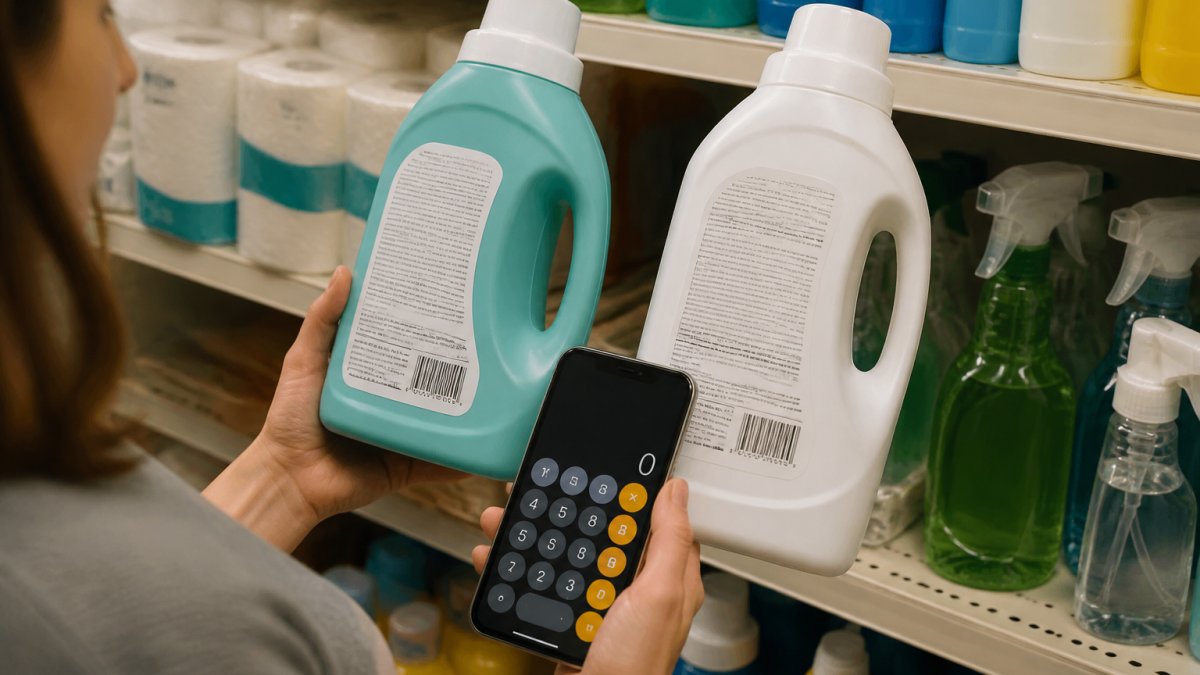
The unit price method is the practice of comparing products by cost per unit (per ounce, per load, per sheet, or per use) rather than by the sticker price on the package. It is one of the most reliable ways to compare household essentials because it helps you evaluate products of different sizes on an equal basis.
Reading Unit Price Tags Correctly
Most stores print a small unit price on the shelf tag, usually in the corner. It shows the price per ounce, per pound, per count, or per 100 sheets.
A common mistake is comparing a 32-ounce bottle to a 48-ounce bottle by sticker price alone. The larger bottle may appear to be the better deal, but the unit price can tell a different story.
Here is the simple formula:
- Cost per unit = total price ÷ number of units
- Example: a 48-ounce bottle at $6.00 works out to 12.5 cents per ounce
- The same product in a 32-ounce bottle at $3.50 works out to about 10.9 cents per ounce
The smaller bottle wins. This happens more often than most shoppers expect, especially during promotions on smaller sizes.
Calculating Cost Per Use Instead of Cost Per Package
Cost per use goes one step further. It asks how many loads, washes, or cleanings you actually get from the package.
Laundry detergent is a great example. A bottle advertising 60 loads at a higher price may actually cost less per load than a cheaper bottle advertising 40 loads. Divide the price by the advertised number of loads to compare, keeping in mind that actual usage depends on how much detergent you use per wash.
Household Items to Buy in Bulk (And What to Skip)
Bulk buying saves real money on some categories and wastes it on others. The difference comes down to shelf life, storage cost, and how fast your household actually uses the item.
What Actually Saves Money in Bulk
Products that are non-perishable, used constantly, and stored easily are the best bulk candidates:
- Paper goods: toilet paper, paper towels, tissues
- Cleaning supplies: all-purpose cleaner, disinfectant, glass cleaner
- Laundry supplies: detergent, dryer sheets, stain remover
- Kitchen essentials: trash bags, foil, parchment paper, sponges
- Personal care: toothpaste, bar soap, deodorant
Many of these products have relatively long shelf lives and are used regularly, making them good candidates for bulk buying. However, larger packages of paper goods and cleaning supplies can require significant storage space, so consider how much room you have before stocking up.
What Loses Value in Bulk
Some products are less suitable for bulk buying, particularly when they have limited shelf lives or aren't used frequently:
- Liquid products that degrade: some cleaners lose potency over long storage
- Scented items: fragrance fades, and you end up replacing them anyway
- Anything your household uses slowly: a two-year supply of a product you use twice a month ties up cash and shelf space
- Items with limited storage life: natural and organic products often have shorter windows than their conventional counterparts
The rule is simple. Bulk buying works when the per-unit savings beat the cost of storing the item and the risk of it going to waste.
Category |
Bulk Buy? |
Why |
|---|---|---|
Paper goods |
Yes |
Long shelf life, but requires storage |
Laundry detergent |
Usually |
Compare cost per load and shelf life |
Trash bags |
Yes |
Compact and regularly used |
Cleaning sprays |
Sometimes |
Consider usage and product stability |
Scented candles |
Sometimes |
Buy based on actual use and discounts |
Personal care |
sometimes |
Check expiration dates and usage |
How to Find Household Essentials for Less Online
Shopping online makes it easier to compare prices across multiple retailers without visiting several stores. However, finding the best value still requires checking more than one source and comparing the total cost of your purchase.
A practical routine looks like this:
- Build a list of your recurring household essentials
- Check two or three sources for each item, comparing unit price, not sticker price
- Factor in shipping and any membership fee before deciding
- Buy non-urgent items in a single order to clear the free shipping threshold
Discount retailers fit well into this routine because their pricing already sits below traditional retail, and their inventory changes often enough that regular check-ins pay off. The trade-off is selection.
That's where The Frugaling Shop can help. Our constantly changing selection of closeout, overstock, and everyday essentials gives shoppers another place to look for great deals. We offer Free U.S. Shipping on $50+ Orders, plus free local delivery in Easley and Powdersville and delivery options in additional Upstate South Carolina areas.
How to Compare Prices on Household Goods the Right Way
Comparing prices on household goods correctly means comparing the total checkout cost for the same quantity and quality of product, not the shelf price of two differently sized packages.
Most shoppers compare the wrong numbers. They see $4.99 next to $6.49 and assume the first is cheaper. That comparison only holds if the packages are identical in size, count, and quality.
Total Checkout Cost vs. Shelf Price
Total checkout cost includes four things the shelf price hides:
- Shipping: free thresholds vary, and paying for shipping can erase a discount
- Membership fees: warehouse clubs charge annual fees that only pay off at volume
- Taxes: applied at checkout, and they scale with the order total
- Minimum order requirements: some retailers only unlock free shipping above a set spend
Membership fees are another cost worth considering. If a warehouse club charges an annual fee, compare your estimated yearly savings against the membership cost. Shopping frequency alone doesn't guarantee that the membership will pay for itself.
Shipping thresholds work the same way. If free shipping kicks in at a certain order total, and you routinely fall short, you are either paying for shipping or buying extra items you did not need. Both outcomes eat the savings.
Store Brands, Coupons, and Loyalty Programs: Stacking Your Savings
Store brands, coupons, and loyalty programs save the most when you stack them on the same purchase instead of using them one at a time.
Store brands, coupons, cashback offers, and loyalty programs can help stretch your household budget even further. When retailer rules allow, combining these savings opportunities can make an already good deal even better.
Coupons and cashback stack on top.
Loyalty programs are another way to make your purchases work harder for you. At The Frugaling Shop, our free Frugaling Rewards program lets shoppers earn 1 point for every $1 spent, with 25 points equal to $1 in rewards. Members can also earn points through additional activities, including social media follows & shares, birthday and referral opportunities.
The key is to compare prices before applying discounts and rewards. A coupon or loyalty offer is only a good deal when the final price makes sense for something you actually need.
Matching Your Buying Strategy to Your Household Size and Storage
The right buying strategy depends on two variables: how many people you are buying for and how much space you have to store it. Neither one is fixed, and neither one should be ignored.

Smart storage solutions can help keep household essentials organized like this Wire Storage Basket Matte Black - Hearth & Hand™ with Magnolia: Metal, Farmhouse Style, Organizational Decor
Use this framework:
- One or two people, small storage: buy smaller package sizes, prioritize unit price over bulk, and keep a short list of items worth stocking when they go on sale
- Three or four people, average storage: bulk buy paper goods, laundry supplies, and cleaning products; skip bulk on anything used slowly
- Five or more people, large storage: bulk buying may offer greater savings on frequently used essentials, especially when your household can use the products before they expire. Compare annual savings against warehouse membership fees before joining.
- Any size, no storage: focus on smaller purchases based on actual household needs. Consider shipping costs and avoid stocking up on products you don't have room to store.
Storage space is the constraint most shoppers underestimate.
For households without much storage, smaller and more frequent orders often win even at a slightly higher unit price, because the savings from bulk never materialize if the product spoils or gets lost.
Conclusion: Small Switches, Real Savings
Saving money on household essentials doesn't require a complete shopping overhaul. Comparing unit prices, choosing the right quantities, watching your storage space, and shopping discount retailers can all help stretch your budget.
At The Frugaling Shop, we make it easier to find everyday savings with a constantly changing selection of closeout, overstock, and value-priced merchandise. Discover great finds at up to 60% off retail, with free U.S. shipping on orders of $50 or more.
Shop Frugal. Bank Loyalty.
Explore Current Frugal Finds →
Frequently Asked Questions
How can I spend less on household items without sacrificing quality?
Focus on unit price rather than package price, and compare products based on cost per ounce, sheet, or use. Bigger packages aren't always cheaper, so check the numbers before buying. Store brands and generic alternatives can offer comparable quality at lower prices, but it's worth checking ingredients, performance, and reviews. Tracking prices over time also helps you recognize genuine discounts. Small, consistent savings habits can make a meaningful difference.
Is it cheaper to buy household essentials online or in stores?
It depends on the retailer, product prices, and additional costs. Online shopping makes it easier to compare deals across multiple stores, but shipping, handling, processing fees, and membership costs can quickly erase potential savings. In-store shopping avoids shipping charges but doesn't always offer the lowest prices. Compare the final cost for the same products and quantities, including taxes and any additional fees, to determine which option offers the best value.
Which household items are worth buying in bulk?
Frequently used household essentials with longer shelf lives are usually the best candidates for bulk buying. Examples include toilet paper, paper towels, trash bags, laundry detergent, and certain cleaning supplies. However, always compare unit prices, check expiration dates when applicable, and consider available storage space. Avoid buying large quantities of products you rarely use or may not finish before they expire or lose effectiveness. Bulk buying only saves money when the products get used and the price is genuinely better.
How can I compare the real value of household goods?
Divide the total price by the quantity or number of uses to compare products fairly. For example, a 100-ounce detergent priced at $12 costs 12 cents per ounce, while a 50-ounce bottle at $7 costs 14 cents per ounce. However, cost per load may be more useful when comparing detergents with different concentrations. Also consider coupons, cashback, loyalty rewards, and any additional fees. Comparing the final cost per unit or use helps you determine which product offers the best overall value.
What is the best website to buy household items cheaply?
The best website depends on what you're shopping for, how much you need, and the total cost of your order. Discount retailers offering closeout, overstock, and value-priced merchandise can be great places to find savings on everyday essentials. Look for reasonable shipping costs, clear return policies, and loyalty programs that offer additional value. Always compare the final checkout price, including shipping, taxes, handling, and other fees, rather than relying on advertised prices alone.
How can I avoid overspending on household essentials?
Start with a shopping list and stick to what your household actually needs. Compare unit prices, track the cost of frequently purchased items, and buy in bulk only when the savings justify the quantity and storage space. Take advantage of coupons, discounts, and loyalty rewards when available, but avoid buying unnecessary items just because they're on sale. Remember, the best deal is one that saves you money on something you were already planning to buy.